








Do you know why a recall happens?
Generally, it happens when a product is found to be unsafe, defective, broken, or not in compliance with the regulations. Recalls are a way to take back the product or the entire lot/batch of the product from the market in order to prevent customers from using it. Recalls can also happen internally, when the issues are detected and the entire batch is taken back from the production line.
Companies generally do this to protect their brand reputation, prevent any sort of harm, and ensure the quality & integrity of the product.
However, the consequences of recalls are always bad. They always result in financial losses, time wastage, loss of customer trust, and production mismanagement. And, that’s why recalls are seen as setbacks rather than a mere solution.
Overview:
Talking about dairy industries, recalls can happen due to contamination, spoilage, expiry, or labeling issues. These recalls can lead to financial losses, invite regulatory scrutiny, disrupt production and distribution lines, affect brand value, and cause customers to lose trust in using that particular dairy product.
During a dairy recall, employees/workforce also face uncertainty, as a recall signals that something has gone seriously wrong in production or quality. The factory owner may blame employees for the mistake, making them worry about their job security. That’s why avoiding dairy recalls through strict quality control and safety measures is so important.
Let’s first understand all the possible recall reasons for the dairy industry in detail.
Why Recalls Happen in Dairy
Dairy products are highly perishable and sensitive to storage, handling, and processing conditions. Common causes of recalls include:
Contamination
- Biological contamination: Presence of harmful bacteria like Listeria monocytogenes, Salmonella, or E. coli.
- Chemical contamination: Presence of pesticides, cleaning agents, or other toxic substances.
- Foreign objects: Pieces of plastic, metal, glass, or other debris found in the product.
Undeclared Allergens
Dairy products may accidentally contain allergens like milk, peanuts, or gluten without proper labeling, which can cause severe allergic reactions in sensitive individuals.
Packaging Defects
Broken seals, leaks, or improper packaging that compromise product integrity, leading to spoilage or contamination.
Improper Storage/ Temperature Control
Dairy products need to be maintained at a strict temperature because they are perishable in nature. If cold chains get broken somehow during processing, transportation, or storage, bacterial growth might occur, causing products to spoil.
Mislabeled Products
Incorrect information such as misleading nutritional facts, expiration dates, or product descriptions, can lead to recalls to prevent consumer misinformation. The companies can also face accusations of misleading customers by hiding information.
Quality Deviation
Production batches that fail to meet required standards for taste, texture, appearance, or safety are pulled from shelves.
Regulatory Non-compliance
Failure to meet government guidelines, testing requirements, or sanitary conditions can result in a recall by health authorities.
When a recall happens, here’s what to do-
Notify immediately –
Inform regulators (FDA, FSSAI, USDA), distributors, retailers, and customers.
Pause distribution –
Halt production/shipment, isolate the affected batch, then resume safe operations.
Identify root cause –
Trace the problem (contamination, mislabeling, packaging failure, etc.) and assess scope.
Communicate openly –
Share clear updates via media and social channels on risks and next steps.
Remove products –
Withdraw affected items from shelves and warehouses; ensure safe disposal.
Correct & prevent –
Do a root-cause analysis, strengthen processes, and improve quality control.
Support consumers –
Offer refunds, replacements, and active customer support.
Document everything –
Keep detailed records for audits and regulatory compliance.
Honestly, despite all the best practices and following all the norms, recalls happen. But handling them efficiently is the key. However, managing recalls manually can be time-consuming and error-prone.
Dairy manufacturers may get panic and miss out on something which can again become more disastrous. Therefore, they must use a tool that can help prevent recalls during production, detect faults early, and manage any necessary recalls efficiently—ensuring that only safe, compliant products reach the market.
An ERP software for dairy industry dedicated for the dairy industry can be of great help here. It will help the manufacturers manage recalls and trace the products efficiently. Adding more, it will help them in optimizing the entire supply chain management.
How does Dairy ERP software help in avoiding recalls?
ERP software for the dairy industry enables dairy manufacturers to respond quickly, minimize damage, and enhance prevention for the future. Here’s how:
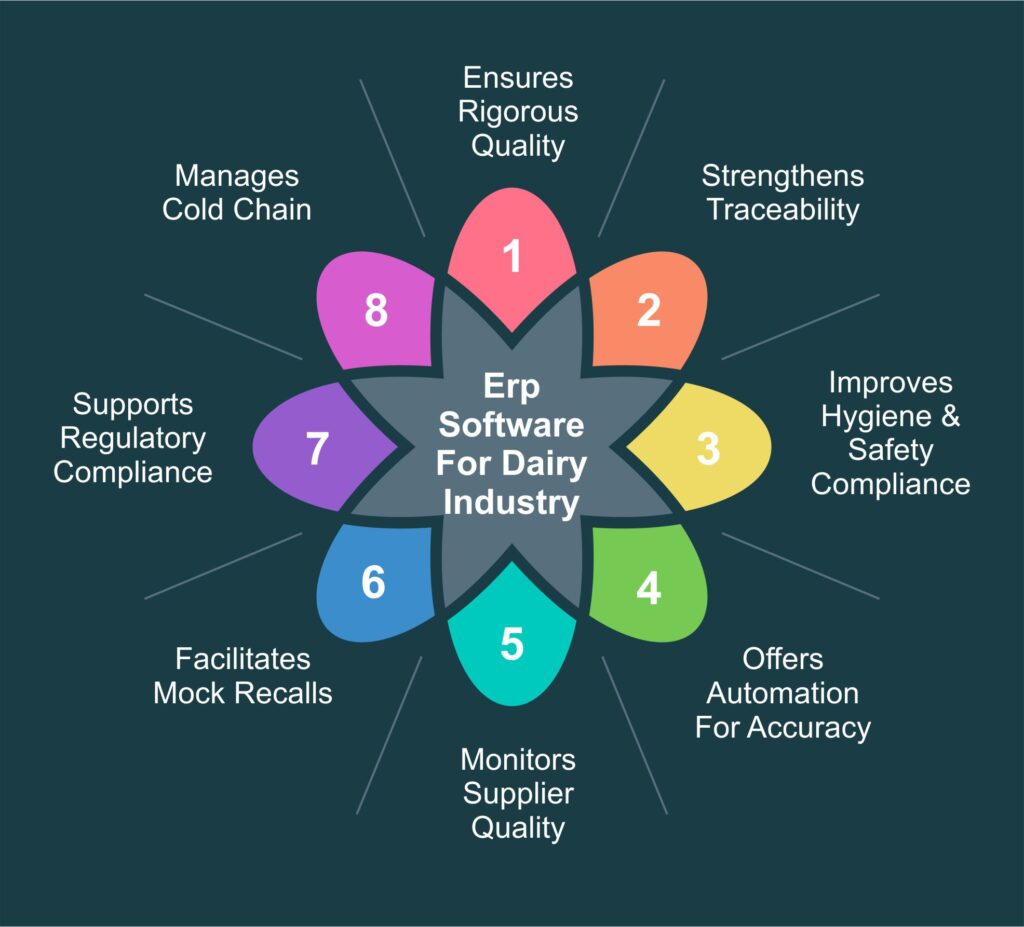
Ensures rigorous quality testing
ERP software integrates with the Quality control module to record and monitor the test results at every stage of dairy production. This means right from raw milk collection to pasteurization, homogenization, and packaging. It keeps an eye on everything and alerts when things are not in order.
For example, ERP software in the dairy industry can track milk fat %, antibiotic residues, allergens, SNF (Solid Not Fat) count, etc. And, it will generate instant alerts if any parameter deviates from the set safety standards. These alerts will help the quality team know that the milk batches are contaminated, and they can stop before they enter the processing line or reach the consumer.
Strengthens traceability
ERP software provides lot and batch traceability. It means dairy manufacturers can trace the entire dairy operations right from the small/big farm collection centers to chilling plants, processing facilities, final packaging, till distribution and vice versa.
In case if any contamination or spoilage is detected, the software will identify that particular batch or the production line, or even the distribution channel, rather than pulling the entire inventory. This will make isolation of the spoiled product easier, and recalls can be done for those particular batches.
Improves hygiene & safety compliance
Dairy manufacturers must emphasize maintaining hygiene and employee safety standards. ERP software helps ensure that the standards, such as Cleaning-In-Place(CIP), sanitation logs, sterilization records, equipment cleaning, employee training, safety masks, etc, are met.
This will also ease their tasks in audits. For example: ERP software in dairy industry can track the cleaning frequency of milk containers or filling machines, ensuring that it is never missed and no contamination happens due to dirt, bacterial growth, allergen cross-contact or other substance.
Offers automation for accuracy
ERP software reduces risks like incorrect pasteurization temperature, wrong fat standards, or missed allergen checks by automating compliance checks and monitoring critical points in real time.
Here, even a small error can lead to big mistakes, for example, in case of deviation in milk chilling temperature, the ERP will trigger an alert. This helps with early fault detection. It also helps isolate and stop defective batches before they leave the plant, ensuring only safe and compliant products are dispatched.
Adding more to it, by ensuring safety compliance, it helps the employees stay safe in such a huge temperature-controlled environment. Like the employee who takes care in a deep freeze zone needs a different type of gloves than those who are involved in heating the milk. This aspect can also be logged in the ERP.
Monitors supplier quality
ERP software maintains detailed records of supplier certifications, farm approvals, and quality test histories. It ensures that only milk from approved collection centers and raw materials from certified suppliers enter the production cycle.
By monitoring supplier performance over time, ERP minimizes the risk of introducing contaminated milk, adulterated additives, or substandard packaging, which could otherwise lead to recalls.
Facilitates mock recalls
ERP software can simulate recall situations for dairy manufacturers to test how well their system responds in case of a real crisis. For example, if a batch of cheese is suspected to be contaminated, the ERP can instantly trace where it was produced, how it was distributed, and which customers received it.
By running these mock recalls regularly, dairy companies can identify gaps in their processes, refine their response, and train employees to act quickly. This preparation ensures that if an actual recall happens, it can be managed smoothly—saving time, money, and brand reputation.
Supports regulatory compliance
ERP software keeps all compliance-related data in one place, making dairy manufacturers stay audit-ready. It records and updates certifications, quality test results, sanitation logs, and batch production data automatically.
For example, it can store results of pasteurization tests, CIP (Cleaning-in-Place) records, and employee training certifications that regulatory authorities like FSSAI, FDA, or USDA may ask for. With this data readily available, dairy plants can meet all food safety standards without scrambling for documents during inspections. This reduces penalties, ensures smooth operations, and strengthens trust with regulators and customers.
Manages cold chain
ERP software supports dairy manufacturers in maintaining strict temperature control at every stage of the cold chain. From raw milk collection at farms to chilling centers, pasteurization, processing, and distribution, the system continuously monitors storage and transport conditions.
For example, it can log real-time temperature data from milk tankers and cold rooms, generating alerts if levels deviate from safe ranges.
Which ERP software works the best for recall management?
A specialized ERP software like BatchMaster ERP is an invaluable tool for supporting rapid product recall management. It is designed with powerful functionalities such as traceability, Quality control, inventory handling, temperature monitoring, and compliance features that help make recall management seamless and fast.
It allows dairy manufacturers to quickly track affected batches, isolate them from the supply chain, communicate with stakeholders, and stay audit-ready—all in real time. This ensures recalls are managed efficiently, with minimum damage to finances, operations, and brand reputation.
Conclusion
If you are a dairy manufacturer and are looking for a reliable partner to streamline your traceability and recall management, along with solving various business complexities, BatchMaster ERP can be your technical ally. Book a demo today to see how it can help boost your business efficiency and reduce recalls…