











Introduction-
For pharmaceutical manufacturers, regulatory compliance isn’t optional — it’s the price of staying in business. The FDA and the EU enforce strict standards on how medicines are produced, documented, and traced, and falling short carries real consequences: failed audits, blocked shipments, product recalls, and significant fines.
UK pharmaceutical manufacturers face this challenge acutely. With a large share of UK drug production destined for export, every batch has to satisfy not just domestic standards but the regulatory expectations of every market it reaches. Manual, paper-based compliance processes simply can’t keep pace with that complexity — which is why more manufacturers are turning to a compliance-focused manufacturing platform rather than a once-a-year scramble before an audit.
Before looking at how ERP supports compliance in practice, it’s worth understanding what the FDA and the EU actually require — and where their rules diverge.
Decoding FDA & EU-
Both the FDA and EU regulations share the same underlying goal: ensuring pharmaceutical products are safe and consistently manufactured. Both define current good manufacturing practice (cGMP) standards with detailed guidance — but they differ in procedure and emphasis.
FDA (US):
Enforces current Good Manufacturing Practices (cGMP), governing the manufacturing, processing, and storage of drugs, with strict documentation and validation requirements.
Oversees drug approval, manufacturing, and labelling within the United States.
Requires thorough documentation and electronic records, including batch records, electronic signatures, and audit trails.
EU:
Enforces EU Good Manufacturing Practice (EU-GMP), similar to FDA standards but with additional emphasis on batch quality control.
Places greater weight on detailed traceability — from raw materials through to the finished product.
Mandates personnel hygiene and clothing protocols, with records of staff qualifications and the specific role each person performed in production.
MHRA (UK):
- Since Brexit, the Medicines and Healthcare products Regulatory Agency (MHRA) is the primary regulator for UK-manufactured pharmaceuticals, operating its own UK GMP framework closely aligned with, but independent from, EU GMP.
- UK manufacturers exporting to the EU or US may need to demonstrate compliance with MHRA, EU GMP, and FDA requirements simultaneously.
How ERP Helps Pharma Manufacturers Meet These Requirements
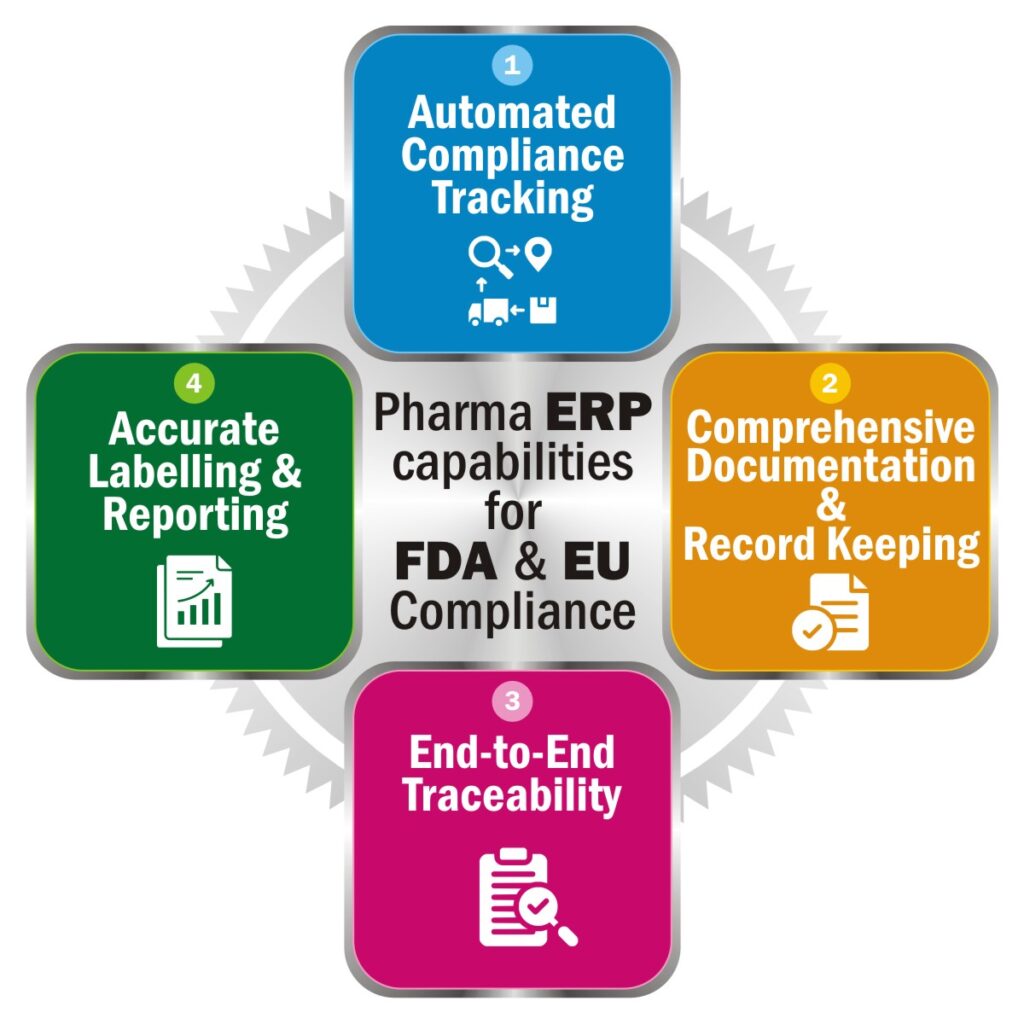
Meeting FDA and EU requirements means satisfying a specific set of obligations: tracking every material and process step, keeping audit-ready documentation, and proving traceability end to end. Here’s how ERP addresses each one directly.
Staying ahead of compliance gaps Rather than discovering a compliance issue during an audit, ERP software flags it in real time. A built-in compliance framework — covering cGMP, drug storage conditions, and related FDA/EU standards — continuously monitors operations and generates alerts the moment a process drifts out of line, so corrective action happens before it becomes a violation.
Keeping documentation audit-ready, always Both regulators require meticulous records, and ERP centralizes them: manufacturing processes, batch records, packaging and labelling details, drug handling and storage protocols, and electronic signatures all live in one digital repository. When an auditor asks for a specific record, it’s a search away — not a filing-cabinet hunt.
Proving traceability from raw material to finished product This is where FDA and EU requirements overlap most directly, and where ERP does the heaviest lifting:
- Raw materials — batch numbers, quality certifications, and supplier details are captured automatically, so only approved materials enter production. Allergen-specific ingredients are tagged and segregated to prevent cross-contamination.
- Production — every stage is logged with process parameters, operator details, equipment usage, and environmental conditions, with real-time data capture that surfaces deviations as they happen, not after the fact.
- Batch tracking — each batch carries a unique identifier tied to its full history (ingredients, process conditions, quality tests, packaging), so if an issue surfaces, the affected batch — and only that batch — can be isolated and recalled quickly.
- Quality checks — QC checkpoints are built into the production cycle, with test results and approval status recorded automatically, ensuring only “QC pass” batches reach the next stage.
- Labelling — batch number, expiration date, allergen warnings, and active ingredient details are populated accurately on every label, satisfying both FDA and EU labelling requirements and keeping products identifiable throughout the supply chain.
MBRs, BMRs, and 21 CFR Part 211
The FDA requires Master Batch Records (MBRs) under 21 CFR Part 211.186 to ensure every batch follows a consistent, pre-approved manufacturing process. It separately requires Batch Manufacturing Records (BMRs) under 21 CFR Part 211.188, to verify traceability and GMP compliance for each individual batch produced.
Generating both manually is slow and error-prone. ERP software produces compliant MBRs and BMRs in a few clicks, pulling directly from the same production data already being captured — eliminating duplicate entry and reducing the risk of transcription errors that auditors flag.
An ERP built around these requirements gives manufacturers a single, auditable system rather than fragmented spreadsheets and manual records. [See how BatchMaster’s pharmaceutical ERP platform applies this in practice]
Closing Thoughts-
Regulatory compliance shouldn’t be a separate workstream bolted onto production — it should be built into it. With the right ERP system, FDA and EU requirements become a natural output of how you already manufacture, not an extra burden on your team.
If you’re evaluating how manufacturing ERP software can support compliance alongside the rest of your pharma manufacturing operations, take a closer look at BatchMaster’s ERP Software for Pharmaceutical industry to see the full platform in action.